Likes Before Paint: How the Feed Became Graffiti's New Blackbook
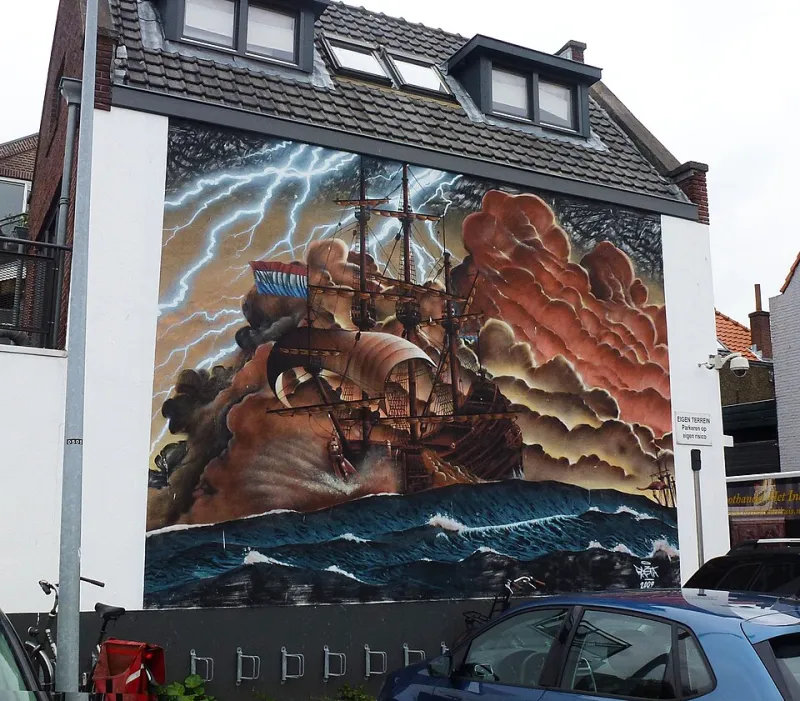
Photo: Rasta, Abderrahim Rasta Hachimi., CC0, via Wikimedia Commons
There was a time when you didn't show your blackbook to just anybody. You earned that. A writer slid that battered sketchbook across a diner table like it was classified material — outlines in pencil, hand styles drilled over and over, a color scheme sketched in the margins next to a note about which hardware store stocked the good Rust-Oleum. If you got to flip through it, you'd been vouched for.
Today? That same sketchbook is a camera roll. And the audience isn't one trusted head at a diner booth — it's forty thousand strangers on Instagram.
The Paper Era
Talk to writers who came up in the eighties and nineties and you'll hear the same refrain: the blackbook was where you became a writer. Not the wall — the page. You pieced letters in pencil first, traced them in ink, refined the flow until the whole thing moved. Veteran NYC writer KEZ, now in his fifties, still keeps three full blackbooks in a fireproof box.
"The book was private practice," he told us. "You'd trade sketches with somebody you respected, and that was the whole social network. One person at a time. Now these kids post a half-finished outline to a million people before the ink dries."
He's not wrong about the shift. But is he right that something's been lost?
When the Feed Becomes the Crew Notebook
Spend ten minutes on graffiti hashtags and you'll see the new reality: sketch swaps in the comments, live-streamed can control drills, timelapses of full productions that hit a million views before the paint's even dry. For writers under twenty-five, the feed isn't a betrayal of blackbook culture — it is blackbook culture, scaled up.
"My DMs are my blackbook," says LUNA, a 23-year-old writer out of Chicago. "I trade outlines with people in Germany, Brazil, the West Coast. My pops' generation traded sketches with whoever was at the yard that night. I trade with the whole planet. That's not worse. That's just bigger."
She's got a point. The old guard romanticizes the paper era, but access to it was gated by geography and who you knew. A talented kid in rural Ohio in 1993 had nobody to trade with. Today that kid has a mentor in Oakland and a critique circle in Melbourne before bedtime.
The Algorithm Picks the Wall
Here's where it gets messy — and where both generations agree something's off. When your sketches perform well online, the pressure to paint what the feed loves gets real. The algorithm rewards bold color, readable letters, clean fills. It does not reward weird experiments, hand styles, or the ugly middle phase of learning.
"I've caught myself scrapping a piece I was hyped on because it wasn't 'feed material,'" LUNA admits. "That's when I knew I had to check myself. The wall should answer to me, not to a metric."
Older writers saw this coming. "The book taught you patience because nobody was watching," KEZ says. "Now everybody's watching, and half of them have never held a can. You start painting for people who don't know what a drop shadow costs you."
What We Gain, What We Burn
The honest answer is that both things are true. The online sketchbook has democratized a culture that ran on gatekeeping — some of that gatekeeping protected the craft, and some of it just kept women, outsiders, and anyone outside the inner circle off the wall. Writers like LUNA found their footing through online communities that would never have opened a paper blackbook to them.
But the private page did something the public feed can't: it let you be bad in peace. Every writer's early work is embarrassing. On paper, that embarrassment stayed between you and your crew. On the feed, it's screenshot forever, and the fear of it changes what people are willing to try.
Sketch Like Nobody's Watching
Maybe the resolution isn't paper versus phone. Maybe it's about keeping one thing that's yours. Some of the sharpest younger writers we talked to still keep a paper blackbook that never goes online — a private lab where the experiments happen before anything hits the grid.
"The feed is my gallery," LUNA says. "The book is my basement. You need both rooms in the house."
KEZ, grudgingly, agrees on one thing: the letters survive either way. Whether they're drawn in a $4 sketchbook or posted to a story that disappears in 24 hours, the work is still the work. The medium changed. The obsession didn't.
And that obsession — the endless redrawing of your own name until it finally looks like you — is the one part of blackbook culture no algorithm can touch.